downloadimg

NH3

$55

4 Series NH3-100 Ammonia Sensor

Product Overview

Product Name: Ammonia Sensor

Model: 4 Series NH3-100

Key Features: Low power consumption, wide linear range, strong anti-interference, stable performance, fast response

1. Product Parameters

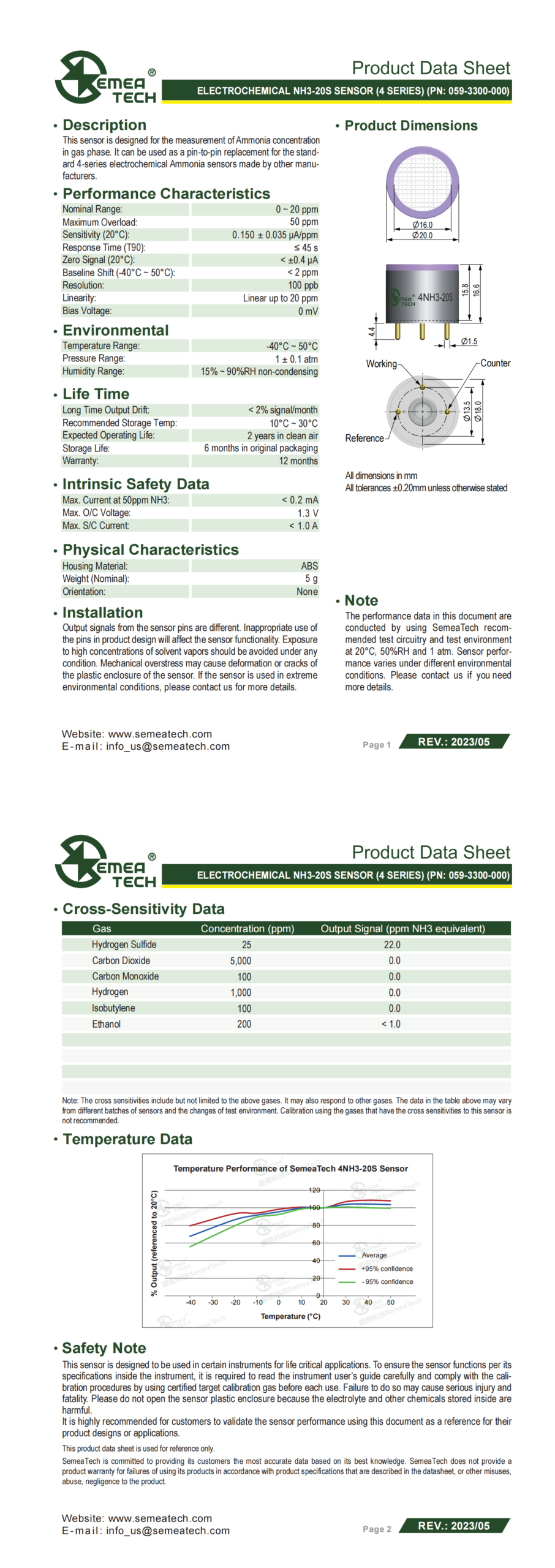
ParameterSpecification
Measuring Range0 ~ 100 ppm
Maximum Load200 ppm
Sensitivity (20°C)0.135 ± 0.035 μA/ppm
Response Time (T90)≤ 90 s
Baseline (20°C)< ±0.4 μA
Baseline Drift (-40°C ~ 50°C)< 2 ppm
Resolution0.5 ppm
LinearityLinear
Bias Voltage0 mV

Note: For other parameters, please contact customer service.

2. Cross Sensitivity

GasConcentration (ppm)Output Signal (Equivalent ppm NH₃)
Hydrogen Sulfide (H₂S)2522.0
Carbon Dioxide (CO₂)50000.0
Carbon Monoxide (CO)1000.0
Hydrogen (H₂)10000.0
Isobutylene1000.0
Ethanol200< 1.0

Note: The above cross-sensitivity is not exhaustive. The sensor may respond to other gases. Cross-sensitivity values may vary by production batch and test environment. Calibrate with target gas before use. Calibration with cross-sensitive gases does not guarantee accuracy.

3. Installation Instructions

  • Ensure correct connection of electrode pins; incorrect connection will affect normal operation.
  • Avoid contact with organic solvents, paints, oils, and high-concentration gases.
  • Do not use adhesives directly on or near the sensor to prevent cracking of the plastic housing.
  • For use in special environments, please contact us in advance.

4. Cautions

  • Use within the specified range only.
  • Sensor characteristics must be tested in clean air.
  • Correct pin connection is mandatory; incorrect pinout will cause functional failure.
  • Do not apply voltage directly to electrode pins.
  • Do not break or bend the pins.
  • Do not subject the sensor to excessive vibration or impact.
  • Do not use if the sensor housing is damaged or scratched.
  • Avoid direct contact with organic solvents, paints, chemicals, oils, and high-concentration gases.
  • Do not solder sensor pins directly; use a matching socket.
  • Do not disassemble or replace any components.
  • If storing the sensor after removal from the PCB, short the working electrode and reference electrode pins to reduce initial stabilization time.
  • For use in non-conventional environments, please contact us.